THE ROYAL ANCESTRY OF EMPEROR VESPASIAN

Updated: Aug 31

INTRODUCTION
The man remembered as Vespasian has long been presented as a hard-driven outsider of modest background – a provincial who clawed his way upward through military competence and talent for survival, eventually restoring order to an empire torn apart by revolts in Judea and civil war. Yet the surviving evidence points in a very different direction. As Guy Edward Farquhar Chilver, Professor of Classical Studies, long ago observed, Vespasian’s revolt and rise to power did not originate with disgruntled or undisciplined soldiers, as the narrative of The Jewish War implies, but was coordinated from above.[1] A large part of his success depended on the support of Herodian royalty – Agrippa II and his sister Berenice – as well as the powerful prefect Tiberius Julius Alexander.
This article develops that line of inquiry. What emerges is not a picture of a self-made commoner, but of a man whose blood ties ran deep into the Herodian and eastern aristocracies. The traditional portrait, still repeated in major biographies by Bernard William Henderson; Barbara M. Levick; and Barry Strauss,[2] rests heavily on what the individual known to us as Suetonius chose to record – and on what he chose to leave out.
Philip B. Sullivan captured the essential point in his important article ‘A note on the Flavian Accession’:
“This paper will offer an explanation and an account of the conspiracy which elevated Vespasian and his brief dynasty to the imperial purple. The evidence will show that the persons supporting Vespasian were all closely connected by ties of blood, marriage or intimate friendship.”[3]
If that is true – and the evidence assembled here strongly suggests it is – then those ties of blood reached farther than anyone has yet been able to acknowledge. This is where the Chalcidian branch of the Herodian dynasty becomes crucial: it is within this line that the previously unnoticed connections to the Flavians actually lie.
Once this context is restored, the genealogy traditionally attached to Vespasian is not merely incomplete; several elements actively invite re-examination. None of this diminishes Vespasian’s ability as a general or administrator. But the “low origins” story begins to look increasingly like a crafted presentation, and the family links that emerge from the Chalcidian and Herodian lines place Vespasian not at the margins of power but squarely inside a network of royal and aristocratic families. The Jewish War, produced by the man known to us as Flavius Josephus, was written after 70 CE – the same period in which the gospels were taking shape, as acknowledged widely in scholarship.[4] Within this tightly controlled literary environment, Vespasian’s official genealogy deserves the closest possible scrutiny.
The figure we know as Gaius Suetonius Tranquillus opens his biography of Vespasian with a noticeable defensive note. He feels compelled to apologise for the emperor’s supposedly undistinguished origins:
“This house was, it is true, obscure and without family portraits, yet it was one of which our country had no reason whatever to be ashamed”.[5]
From the outset – and repeatedly throughout his account – Suetonius insists on Vespasian’s humble background. He emphasises the absence of noble ancestors, recounts Vespasian’s mockery of Romans who invented patrician pedigrees,[6] and claims Vespasian refused any flattery that linked him distantly to a patrician family descending from a major deity. And yet, the moment Vespasian’s reign began, he established a priesthood in honour of his family and permitted their worship. [7] His dynasty was elevated to divine status with remarkable speed. The contrast between this public theology and the biographical appeals to a modest birth is difficult to miss.
Equally revealing is the narrow scope of Suetonius’s genealogical knowledge. He claims he can trace Vespasian’s ancestry no further than his paternal and maternal grandfathers. Titus Flavius Petro, the paternal grandfather, is presented as the first member of the family to achieve any distinction at all – a convenient detail for the construction of a “self-made emperor”.
Again, the evidence here leads elsewhere. Through his mother, recorded as Vespasia Polla, Vespasian emerges not as the descendant of obscure Sabine farmers but as a member – though a junior one – of the Herodian royal house.
Vespasius Pollio (I) and Herod, King of Chalcis – referred to in several later sources as Herod Pollio – appear, at face-value, to be entirely different men, linked only by their shared proximity to Berenice. But once we move beyond a surface read, the overlap becomes much harder to dismiss. Both figures operated within the same narrow corridor of power: the Roman imperial court on the one hand, and the Herodian dynastic world on the other. These were circles in which names, roles, and family alliances frequently blended, shifted, or were presented differently depending on the audience.
Once Vespasius Pollio (I) and Herod of Chalcis are placed side by side – and their naming patterns, generational positions, and political roles are compared prosopographically – identifying the names as belonging to separate people becomes increasingly difficult to maintain. The alignment of chronology and naming structure strongly suggests that the ‘Vespasius Pollio’ preserved in Roman biography and the ‘Herod Pollio’ preserved in eastern genealogical traditions are variants of the same individual.
This, in turn, places Vespasian’s mother, Vespasia Polla, within the Chalcidian branch of the Herodian family – a position that explains her later role as the wife of King Tigranes VI of Armenia and her appearance on the coinage of his second reign, with Tigranes also being a descendant of Herod the Great. This family background of Vespasian’s mother would explain her children’s rapid ascent far more persuasively than the tidy but implausibly humble sketch preserved by Suetonius.
I am fully aware this is a bold claim, but it arises from a much broader investigation into connections between the Roman-Jewish War of CE 66-73 and the emergence of the Synoptic gospels. That investigation produced a number of suspicions about the received account of Vespasian’s ancestry, particularly when the sequential parallels between The Jewish War and the gospels are considered alongside the archaeological problems surrounding Nazareth. The location later identified as Nazareth lies in the area around Japhia where the Roman campaign in Galilee began, making its place within the gospel narrative especially interesting. I examine the Nazareth evidence here, the wider historical problem concerning Jesus on the Current Project page, and the sequential parallels between War and the gospels in detail here. The analysis of the parallels uses the Loeb Classical Library and Teubner Greek texts.[8] It is also important to understand that the point isn’t any single match; it’s the pattern that emerges when you see them all together. Not only do The Jewish War and the gospels move through events in the same narrative order, each builds the story around a figure of apparently humble origins who becomes the bringer of “peace”. This shared structure is striking, and it was precisely this overlap that brought the inconsistencies in Vespasian’s presented genealogy sharply into view.
NEW DISCOVERIES THROUGH NEW RESEARCH
The information surrounding Vespasian’s ancestry and rise to power becomes increasingly suspicious when three lines of evidence are examined together: (1) the members of the Herodian royal family who actively supported him; (2) the sequential parallels linking The Jewish War, Jewish Antiquities, and the Gospels; and (3) the difficulties that arise when we try to reconstruct the true background of the man known as ‘Titus Flavius Josephus’, who gives his birth name as ‘Yosef ben Matityahu’. Taken together, these strands raise questions that cannot be easily ignored.
Josephus, we are told, was treated with extraordinary favour by the Flavians – a stark contrast to the fate of other Jewish leaders such as Simon bar Giora, who was paraded and executed after the triumph (War, Volume 3, Book 7, pages 511-15).[9] Yet Josephus himself reports that during the siege of Jotapata (Yodfat) in 67 CE, he ordered boiling oil to be poured onto the Romans below, and boiling fenugreek to be tipped over their assault ramps (War, Volume 2, Book 3, pages 655-57). The result, he says, was horrific: Roman soldiers burned in agony, and their flesh was consumed. That someone responsible for such violence should later be welcomed into the Flavian household is, at the very least, noteworthy.
With this in mind, before turning to the evidence for Vespasian’s actual genealogy, it is helpful to sketch the background. His rise took place in the midst of the Roman-Jewish War – a conflict driven by deep political and religious tensions between Rome and Judea, and accompanied by mounting instability in Rome itself, where Emperor Nero was increasingly hated by the senate and aristocracy.
Within Judea, two sects (groups) in particular – the Scribes and Pharisees; the latter of which would lay the foundation for what became rabbinic Judaism – represented a serious challenge to both the local aristocracy and the Roman order it supported. The Pharisees especially pushed for a redistribution of religious authority, greater protection for ordinary people, and social reforms that threatened elite power. In this sense, they were natural opponents of both the Herodian rulers and the aristocratic interests aligned with Rome. This is also why, in the New Testament, the Pharisees are consistently portrayed as the antagonists and as foils to the Jesus character; their wisdom is presented as inferior.
These points can be seen clearly when reading the Talmud, which emphasises reasoning, debate, and practical ethics over rigid religious belief. For supporting evidence that many Pharisees opposed slavery, see Jewish Slavery in Antiquity (p. 10) by Catherine Hezser. She notes that while Jews certainly owned slaves in antiquity, the rabbis regarded enslavement itself as a reversal of the Exodus experience – an ethical stance that placed them at odds with the aristocratic establishment.[10]
The Pharisees also resisted the use of religion as a tool for extracting wealth from the population. By contrast, the priestly elites of this period compiled and administered laws that granted themselves a substantial share of the tithes and offerings:
“Thus ye also shall offer an heave offering unto the LORD of all your tithes, which ye receive of the children of Israel; and ye shall give thereof the LORD'S heave offering to Aaron the priest.” (Numbers 18:28)
Jewish Antiquities describes religion as a highly profitable enterprise:
“and they continued day by day to enrich the altar with costly sacrifices” (Jewish Antiquities, Volume 6, Book 9, p. 89, Loeb)
Tithes and sacrifices were divided by percentage among the High Priests, who sent the larger share to the local king – in Judea, the Herodian ruler – and he, in turn, forwarded tribute to Rome. The Life of Josephus confirms the financial scale of this system:
“My colleagues, having amassed a large sum of money from the tithes which they accepted as their priestly due” (p. 27, Loeb)
The amounts expected from tithes were not vague guesses – they were recorded, tracked, and anticipated by both the High Priests and the king. This meant that, year after year, enormous wealth was drawn from the population in a highly predictable and tightly managed system. When the Pharisees challenged or disrupted this flow, the ruling elites naturally felt their revenue was being threatened. It is in this context that groups such as the Sicarii or zealots are labelled in sources as ‘robbers’: the term served to cast them as criminals rather than as opponents of an exploitative structure. The aristocratic class – both Jewish and Roman – had a strong interest in maintaining the daily sacrificial system, which generated continuous income and reinforced authority.[11] Beneath all of this lay the long-running internal struggle between the Pharisees and the Sadducees, a conflict that deeply alarmed the wider aristocracy of Rome.
Trouble eventually arose for the Sadducean sect – the group made up of the high priest, leading aristocratic families, and the wealthy merchants – because many ordinary people regarded them as corrupt and politically self-serving. Several Hasmonean rulers, moreover, openly favoured the Pharisees, allowing them at times to gain influence over the Hasmonean court itself. The long-standing tension between Pharisaic leaders and the Hasmonean dynasty created deep internal fractures, and under later Hasmonean rulers such as Alexander Jannaeus (127-76 BCE), the conflict hardened into a bitter divide between the Pharisees and Sadducees.
The Pharisees had become so popular with the ordinary people that they gained both public backing and financial support. In practice, this meant they were increasingly the group “running things”. The Jewish War repeatedly hints at their influence, describing them as “the real administrators of the state...In short, the enjoyments of royal authority were theirs...if she [Salome] ruled the nation, the Pharisees ruled her” (Volume 2, Book 1, pages 53-5). Elsewhere they “hold the position of leading sect’ (Volume 2, Book 2, p. 385 ), “cultivate harmonious relations with the community” (Volume 2, Book 2, p. 387), and are shown as deliberating on major decisions, “the principal citizens assembled with the chief priests and the most notable Pharisees to deliberate on the position of affairs” (Volume 2, Book 2, p. 485).[12] Together these passages make clear that the Pharisees had achieved a level of authority that deeply unsettled both the Sadducean elite and those aligned with Rome.
Once the Pharisees had gained this kind of authority, their opponents turned to Rome’s aristocracy for help in curbing their influence. Rome responded by elevating Herod to the throne of Judea – making him, in effect, “King of the Jews” on Rome’s behalf. The Pharisees’ power had come from popular support and moral authority, not from holding formal government office. They were not an elite ruling class, but a group whose influence threatened those who were.
VESPASIAN’S GENEALOGY
As the war escalated, the Sadducean leaders and their supporters, along with other Jews, were left behind in Judea, while the Herodian royal family appears to have been evacuated to Rome shortly before the siege of Jerusalem.[13] Queen Berenice and King Agrippa II - both descendants of Herod the Great – were treated conspicuously well by the Flavians. A straightforward explanation is that Agrippa had attempted to persuade the people that resistance against Rome was hopeless; when this failed, he openly supported Rome and even joined Vespasian’s campaign.
But once one critically examines Josephus’ genealogy - the results of which will be presented in my next book - and compares it with the available information on the Herodians and Flavians, a number of individuals begin to stand out. Scattered details of dates, locations, and family ties merge in ways that reinforce the connections being investigated here. Even the brief line in Romans 16:10 – “Salute those of the [household] of Aristobulus. Salute Herodian, my kinsman” – hints at relationships that deserve closer attention. It is sometimes argued that this phrase refers only to shared Jewish identity, not literal kinship. Yet the combined genealogical and chronological patterns presented here point far more strongly toward an actual family link – one that fits naturally within the Herodian-Flavian network this article reconstructs.
Before long, one encounters a pattern that cannot be ignored: certain names and family lines reappear across both Roman and Herodian spheres precisely where Vespasian’s ancestry grows obscure. These are not random overlaps. They cluster around the generations that matter most – the very places where Suetonius’s account becomes thin, and it is exactly where a Herodian-Flavian link would fall that Josephus suddenly becomes uncharacteristically vague, providing fewer names and thinner details than elsewhere. The most revealing of these is the figure to whom we now turn.
One name that recurs with particular force in this period is Pollio, seen most clearly in the case of Vespasius Pollio (I). Alongside him stands Herod of Chalcis – known variously in the sources as Herod II/III/IV/V and as King of Chalcis, and holding at one point the titular rank of praetor (magistrate or military commander; a formal position without much real authority).[14] Although ancient authors do not record the name Pollio for him, the naming patterns that emerge from his descendants, and the naming habits of the Chalcidian branch more generally, make the comparison between these figures increasingly meaningful.
Both figures – Vespasius Pollio on the Roman side and Herod of Chalcis on the Herodian – belong to the same tight-knit world in which elite families, clients, and royal houses frequently overlapped. Herod of Chalcis was a grandson of Herod the Great and Mariame I, and son of Aristobulus IV. Aristobulus himself had spent several formative years in Rome in the household of Gaius Asinius Pollio and his son Asinius Gallus, a connection that shaped the Roman-facing identity of his descendants, as we shall see.[15] Herod of Chalcis married twice. His second marriage, in 44 CE, was to his niece Julia Berenice, then only sixteen; she was the sister of Agrippa II and the daughter of King Herod Agrippa I (Herod’s own brother), and therefore the granddaughter of Aristobulus IV.
The marriage produced two sons, Berenicianus (Bernicianus) and Hyrcanus, and ended with Herod’s death when Berenice was about twenty. His first marriage, probably in the late 20s CE, was to Mariamme IV, daughter of Joseph ben Joseph (a nephew of Herod the Great) and Olympias the Herodian. From this marriage came a son, Aristobulus – later known as Aristobulus of Chalcis when he assumed the small Chalcidian kingdom in 57 CE.[16]
Pollio was a familiar Roman name, turning up often enough among citizens and families tied to the imperial system. What becomes striking, however, is what happens when dates, relationships, and the life-circumstances of Vespasius Pollio are set alongside those of Herod of Chalcis. Two figures who normally inhabit entirely separate discussions begin to line up with a kind of unnerving symmetry. At this point, no more is being claimed than that the parallels are hard to ignore; yet they do open the door to the possibility that Herod may, in some context now obscured to us, have borne or adopted a name from the same circle of usage. This, in turn, invites the question of whether Vespasius Pollio in the Roman record and Herod of Chalcis in the Herodian record might reflect two aspects of a single career, seen through different administrative and literary filters:
Vespasius Pollio, whose wife is unnamed in history, is recorded as an equestrian who resided in Nursia and became a tribunus militum in a legion three times; those of equestrian rank who served as military tribunes often became senators. The record also states that he became a praefectus castrorum (camp prefect, the third most senior staff officer of the Roman legion) no earlier than the time of Augustus (63 BCE – 14 CE - reigned 27 BCE – 14 CE)[17] I will note here that epigraphic evidence has been found in Nursia (modern Norcia) which appears to provide evidence of Vespasian’s family living there.[18] Interestingly, Geza Alfoldy states on p. 157 in the source in the footnote just given, “we know a Roman who was born in Nursia...This is Vespasius Pollio’. But Suetonius, our source, does not say Pollio was born in Nursia. This is only presumed. What Suetonius does say is that his daughter Polla was born of “an honourable family at Nursia”[19]
Herod of Chalcis (born 10-9 BCE - died 48-49 CE), son of Aristobulus IV and brother of Herod Agrippa I and Herodias, was taken to Rome after the death of Herod the Great, and was given the praetorian rank and a principality.[20] He was granted the kingdom of Chalcis in 41 CE by Emperor Tiberius Claudius Caesar Augustus Germanicus (10 BCE – 54 CE); it is important to note that Chalcis is modern day Aanjar, and is next to the Beqaa Valley, which was a source of grain for the Roman provinces. The birth date for Herod is concluded from coinage, found in modern Lebanon,[21] the ages of the wives and sons and information provided in Jewish Antiquities, Volume 9, Book 19, p. 381 (Loeb). There we read Agrippa I was in his fifty-fourth year when he died in the summer of 44 CE. If his fifty-fourth year began in late 43 CE, his birth may be concluded as being in the late 11 BCE; Aristobulus I/IV returned from Rome in late 12 BCE and died in 6-7 BCE.
Vespasius is recorded as having a son and daughter. The daughter’s name is recorded as Vespasia Polla/Pollia. The name used for the son is Vespasius Pollio (II), although the name is not given in the historical record.[22] Suetonius records that this son became a senator with the rank of praetor, a position which carried extensive authority in the government. Suetonius describes Vespasia Polla’s family as equestrian and honourable (equestris familiae et honestae), a background that likely placed her socially above her husband, the tax collector, Titus Flavius Sabinus I. Suetonius notes that Sabinus I:
“farmed the public tax of a fortieth in Asia... and ... there existed for some time statues erected in his honor by the cities of Asia”
Vespasian’s early education was the responsibility of Tertulla, his paternal grandmother. It appears, then, that his mother and father were away on business for long periods. Suetonius also states that apparently many monuments of the family of the Vespasii were still to be seen in his time at a village called ‘Vespasiae’ between Nursia and Spoletum, therefore, in the Sabine country, affording strong proof of the renown and antiquity of the house.[23]
When we look more closely at the evidence for the wider Herodian family in the first century, one figure stands out as especially revealing: King Julius Tigranes VI of Armenia. Born before 25 CE[24] and raised in Rome, [25] he was not only a Roman client king but also a great-grandson of Herod the Great through his father, Gaius Julius Alexander, [26] son of Alexander and Glaphyra. Alexander, in turn, was the son of Herod the Great and Mariame I, which means that Tigranes’s grandfather was Alexander – the brother of Aristobulus IV.
The family line is summarised in Jewish Antiquities, Volume 9, Book 18, pages 94–5 (Loeb):
“Alexander, King Herod’s son, who had been put to death by his father, had two sons, Alexander and Tigranes, by the daughter of Archelaus king of Cappadocia. Tigranes, who was king of Armenia, died childless after charges were brought against him at Rome. Alexander had a son who had the same name as his brother Tigranes, and who was sent forth by Nero to be king of Armenia.”
This places Tigranes VI firmly inside the Herodian family, through exactly the same branch that produced Herod of Chalcis, even if his later political life unfolded on the Armenian frontier (first reign 58-61 CE; second reign 66/7 CE).
Tigranes married a woman known to us only from the coinage of his second reign. Her name is not given on the coins, nor do they provide any information about her background, so scholars relied instead on the image of her.

It was this image – especially the ‘Phrygian cap’ – that has led to conclusions that she was a Phrygian woman. However, Frank L. Kovacs suggests that it may instead present her as a personification of Armenia, and draws a comparison with the Nero and Armenia relief in the Sebasteion-Sevgi Gonul Gallery at Aphrodesias, where Nero is shown subduing a female figure wearing a ‘Phrygian cap’ as Armenia personified,[27] a design chosen to appeal to Armenian viewers. No literary source mentions her and so the coins are all we have – and as Kovacs has argued in ‘Tigranes IV, V and VI’, her appearance only in the second reign suggests either a recent marriage or a newly emphasised position.[28]
Tigranes and his queen had at least two children. Their daughter, Julia, is identified by a Falerii inscription, in Etruria, in which Julia Ammia, daughter of King Tigranes, dedicates a monument to the Great Mother; Julia married the Roman senator M. Plancius Varus of Perge:
EX VOTO MATRI DEUM MAG(NAE) DIACRITAMENAE [I]ULIA TIGRANIS REGIS F(ILIA) AMMIA [a] SOLO FECIT IDEMQUE DEDICAVIT[29]
Translation:
To fulfil a vow to the great mother of the Gods Diacritamenae, Julia Ammia, daughter of King Tigranes, raised (this monument) from the ground and likewise dedicated it
Her brother, Gaius Julius Alexander, appears in our sources as a Roman-appointed client ruler of the small Cilician territory of Cetis, governing jointly with his wife Julia Iotapa. Their eldest son would later enter the Roman senate and eventually rise to the consulship. Both Julia and Alexander were therefore great-great-grandchildren of Herod the Great and Mariame on their father’s side. Julia’s name naturally mirrors her father’s Julius, but it also quietly echoes Julia Berenice (Berenike, Bernice), second wife of Herod of Chalcis.
Aristobulus IV, father of Herod Chalcis, was raised in the household of Asinius Pollio, a devoted friend of Herod the Great and one of the most distinguished Romans of his generation. Pollio’s son, the orator Asinius Gallus, carried the family’s extra or alternative name. Although the Jewish War and Jewish Antiquities do not record later contact, such foster-household ties usually created lasting patronal links; and Pollio’s known interest in Judean affairs makes it likely that these links continued.[30] Herod of Chalcis was not himself raised there, but he would have inherited his father’s Roman connections – including names and the circle of relationships of Asinius Pollio and his son Asinius Gallus.
Another small clue helps to fill out the background. Asinius Pollio was active in central Italy during the upheavals of the Perusine War, a conflict that directly affected the Sabine region and towns such as Nursia. Suetonius, meanwhile, presents Vespasia Polla’s family as Sabine landowners of some standing, and later tradition places Vespasius Pollio himself firmly within this same regional world. Far from being incidental, this overlap shows that the Pollio-Gallus circle belonged to the same social world from which Vespasian’s own family emerged.
Once we set this naming landscape in place, the later family of Tigranes and his queen demands a closer look, especially because a grandson of Tigranes and his queen was called Gaius Julius Alexander Berenicianus, with the name Berenicianus only seen used before for one of the sons of Herod of Chalcis and Julia Berenice. In the Herodian dynasty everyone is accounted for, generation by generation, but the wife of Tigranes is the one figure who sits exactly where a Herodian-Berenice family line could have slipped through. Not necessarily through direct descent from Berenice, but through the sort of household reshuffling the Herods practised with remarkable ease. Her position suddenly becomes far more intriguing than her brief appearance on the coinage might suggest.
Edmund Groag, writing in the Pauly–Wissowa Realencyclopädie, also observed that Berenicianus occurs also in the line of Herod of Chalcis and Julia Berenice, and therefore must be explained by a maternal Herodian connection, most plausibly associated with the Chalcidian branch.[31] Working before the Herodian genealogy was more fully reconstructed, Groag could not identify the woman in question, but his central point, that the name demands a Herodian source, has endured.
Tal Ilan later revisited the problem from a fuller prosopographical position. She accepted Groag’s basic point: Berenicianus points to the Herodian house of Chalcis, the family of Queen Berenice. Ilan also suggested that the mother of Gaius Julius Alexander Berenicianus was also called Berenice, perhaps Berenice III, born after 50 CE and the daughter of Mariamme and Julius Archelaus, mentioned in Jewish Antiquities, Book 20, pages 76–7 (Loeb), and that she might lie behind the name.[32] This is a sensible suggestion, but it remains a guess. If Berenice III is made the mother of Gaius Julius Alexander Berenicianus, the suggestion conflicts with the usual reconstruction in which he was the son of Gaius Julius Alexander of Cetis and Julia Iotapa.[33]
If she is instead made the wife of Tigranes VI and mother of Gaius Julius Alexander of Cetis, the problem is not solved either. Josephus only says that after Mariamme separated from Archelaus she went to Alexandria with her daughter, and the positive identification trail stops there. No source connects her, or any descendant of hers, with Alexander of Cetis, Tigranes VI, Tigranes’s queen, or the Tigranid family line.
Commenting on this, Dr. Nikos Kokkinos does not make Berenice III available for marriage into the family of Tigranes VI. When discussing the mother and daughter moving to Alexandria, Kokkinos cautiously identifies Berenice III with the Berenice later found married to Alexander of Cyrene. That identification rests on name, chronology, and the Alexandrian setting, not direct evidence. Even so, it means Berenice III cannot simply be moved into the family of Tigranes VI as the missing explanation for the name Berenicianus.[34] So modern scholarship has had to leave, or tended to leave, the problem where it stood. Kokkinos, in his major reconstruction of the Herodian dynasty, accepts that the name Berenicianus must reflect a Herodian source, but because both Tigranes VI and his father Alexander II appear with unnamed wives in the surviving genealogies, he concludes only that the name must honour some Herodian Berenice. He allows that it might preserve the memory of Agrippa I’s daughter, Berenice II, or perhaps an otherwise unknown bearer of the name. But he ultimately had to accept the underlying difficulty: the path by which the Berenicianus name entered the Tigranid family remains unaccounted for.
This is precisely the gap Groag had already identified, and which Ilan later sharpened – the name points specifically to the Chalcidian branch, but the woman who carried it into the line
had yet to be found.
It is worth stressing that the dynastic name Tigranes itself tells us nothing here. As the Greek rendering of the Old Iranian Tigrāna, it is simply the expected Armenian royal name used by the Artaxiad and later Armenian royal houses. The Armenian element is visible precisely where we would expect it: in the name of Tigranes VI himself. By contrast, the Herodian names appear only among his children and later descendants. No Armenian naming practice can explain them.
Modern evidence has sharpened the picture. Since Tigranes’s father, Alexander II (15 BCE-26/28 CE), was a grandson of Herod the Great through Herod’s son Alexander I, the Herodian element could in principle have come through the paternal line alone. But the appearance of the name Berenicianus cannot be explained this way. The famous Berenice (daughter of Agrippa I) was born in 28 CE and by then Alexander II was already dead. Besides, he was already married with children, and she married Marcus Julius Alexander in the early 40s CE.
Nor can the solution lie with Julia Iotapa, wife of Gaius Julius Alexander; as a princess of Commagene, she brought no Herodian ancestry into the line and cannot account for the distinctive name.
But it is natural to wonder whether Alexander II’s unnamed wife might simply have been called Berenice? After all, an empty space in a family tree can be tempting. Yet no ancient writer ever gives her name, and modern scholars have been careful not to conjure one to fill the gap. She remains exactly what the sources make her: a shadowy figure we can place, but not describe. And a blank space cannot explain a name as pointed as Berenicianus. Nothing about this unknown noblewoman gives us anything we can use to discover who she was. So no Berenice appears in the paternal branch. The Herodian name Berenicianus must therefore come through the mother, Tigranes VI’s queen.
The Herodian family, moreover, was not in the habit of marrying outsiders. From Herod the Great’s generation onward, the dynasty arranged its marriages within a strikingly narrow pool of families: cousins married cousins; uncles married nieces and grandnieces, and unions with neighbouring client dynasties (Cappadocian, Nabataean, Emesan) reinforced existing political alliances. Once the family entered Roman high society, marriages with senatorial households followed the same logic of status and strategy. Josephus is explicit about these patterns. Royal marriages were instruments of legitimacy, not casual or provincial affairs, and the dynasty almost never married into families that left no trace in our sources.
Knowing this, the modern assumption that Tigranes VI – a Roman-raised Herodian prince – took as his queen an otherwise unknown ‘Phrygian noblewoman’ becomes difficult to justify. Such a match would be an anomaly without parallel in the entire Herodian record. By the Roman period it could mark eastern or Anatolian identity more generally, and in this context Kovacs’s comparison with the Nero and Armenia relief points away from a literal Phrygian woman conclusion.
The cap is best explained as presenting Armenia personified, or at least as using a visual language suitable for Armenian rule. It shows how the queen was meant to be seen on coinage, not where she came from. Nor would a Phrygian noblewoman be an obvious marriage for Tigranes VI. Phrygia was not in Armenia, and by Tigranes VI’s time it was not a neighbouring client kingdom with a ruling house. It was a region within the Roman provincial or regional world, divided between Asia and Galatia. Phrygia had local civic elites, but no native royal house that could explain such a marriage.[35] A local aristocrat from Roman provincial Phrygia might have been wealthy, Greek-speaking, and socially respectable, but she would not obviously strengthen Tigranes’s claim to Armenia, connect him to a neighbouring client dynasty, or link him to a known Roman political family. Unless such a woman can be connected to a significant Roman-backed family, and no source does this, the proposed Phrygian marriage gives no clear political explanation.
Furthermore, all later generations – Julia Ammia, Gaius Julius Alexander, Gaius Julius Alexander Berenicianus, and the second-century Julia Crispina of the Babatha archive[36] – remain identical regardless of which route the Herodian ancestry took. Modern genealogy simply modifies Groag’s reasoning – since Tigranes’s father was himself a grandson of Herod the Great, Herodian names could have reached the children through the paternal side. What remains valuable, however, is Groag’s instinct that the Chalcidian branch is the source of the anomaly.
The best conclusion is that Tigranes’s queen belonged to the Roman-backed Chalcidian branch of the Herodian dynasty as a daughter of Herod of Chalcis (Herod Pollio).
This identification being correct means the children of Tigranes VI – Julia and Gaius Julius Alexander – were descendants of Herod and Mariame twice over. Through their father they descended from Alexander, son of Herod and Mariame, and through their mother they descended from Aristobulus IV, Alexander’s brother. This double descent helps to illuminate the next generation: C (Gaius). Julius Alexander, king in Cilicia, named his son C (Gaius). Julius Alexander Berenicianus,[37] blending the Julio-Claudian element with the Herodian name. A possible remote descendant of this line has been proposed on the basis of a second-century CE inscription from Heliopolis/Baalbek:
Tiberius Claudius Antoninus Calpurnius Atticus Julius Berenicianus
TI(BERIO) CLAUDIO ANTONINO C[AL]PURNIO ATTI[CO] [IUI]IO [B]ERENIC[IANO] TI(BERI) CLAUDI A[NTONI]NI ATTICI [F](ILIO) - (IGLSyr 6 2784)[38]
Groag himself later noted the rapid spread of the name Berenicianus in the region around Chalcis – precisely where Berenice, wife of Herod of Chalcis, had been queen.[39]
‘VESPASIUS POLLIO’ AS A PSEUDONYM OF HEROD POLLIO
If we put the scattered scraps of evidence side by side, something rather awkward happens to the tidy distinction between ‘Vespasius Pollio of Nursia’ and ‘Herod of Chalcis’. On paper they look like two different men, moving in two different corners of the empire. But the closer we look, the more the outlines blur. We see each figure with a son and a daughter moving in elite circles at exactly the same time. Each turns up with deep Roman connections on the one hand and unmistakably Herodian ones on the other. And both careers are documented just enough to tempt us, but never quite enough to make the story straightforward. Familiar territory for anyone who has ever tried to reconstruct a first-century family tree.
The children of ‘Vespasius’ suddenly match the children already known in the Chalcidian line. His otherwise anonymous wife fits the chronology of Herod’s marriage to Mariame. And when their careers are laid side by side, they align rather more closely than two independent lives ought to. The figure Suetonius calls Vespasius Pollio and the figure Josephus calls Herod of Chalcis turn out to be the same man viewed through two different lenses – Roman administrative and Herodian dynastic. Even the portraits seem to nudge us in that direction. Set the coins of Agrippa II beside those of Vespasian (born in 9 CE, as Suetonius tells us), and the family likeness is surprisingly strong. It makes perfect sense if both men descended, through different paths, from Herod the Great. In that scenario Agrippa II emerges as Vespasian’s first cousin once removed – and, through Vespasian’s mother, his great-uncle as well.

Fig. 1
It is possible, of course, that this man used different identities in different corners of the Roman world. This would hardly have been unusual. Elite provincials routinely adopted Roman names in Roman settings and Herodian ones in Judaean circles, and later authors simply preserved whichever version suited their narrative. We cannot say with certainty that Herod Pollio ever styled himself ‘Vespasius Pollio’, but the cultural pattern makes such an overlap far from surprising. In this case, the naming environment surrounding Herod, king of Chalcis, shaped by the Roman-Herodian circles inherited from Aristobulus IV’s upbringing in the Pollio household, offers a strong starting point for investigating more. It is precisely the sort of pattern we see when a single individual, or his immediate family, moves between imperial service and eastern royalty, their identities refracted differently in different sources. For clarity, then, I refer from this point to Herod of Chalcis simply as Herod Pollio – not because ancient authors use this name, but because it reflects the naming pattern visible through his father’s upbringing.
If the Vespasius Pollio of Suetonius represents the same individual whom Josephus calls Herod of Chalcis, the discrepancy between the two names becomes more than a biographical curiosity. It speaks to the way identities could be reshaped, muted, or reframed as they passed through different hands. In a world where ancestry carried political weight, the names preserved by Roman writers could emphasise one face of a man’s career, while Judaean sources preserved another. Such choices did not need to be part of any grand design to have a powerful effect: they could, quite naturally, blur the lines of descent, obscure certain connections, and allow ambitious families to present themselves in the form that best suited the moment – for example, framing a future emperor as a man of humble stock rather than as a member of the increasingly intertwined Roman–Herodian elite whose marriages and alliances quietly underpinned power after 70 CE.
The classicist Gilbert Highet noted that Roman culture was full of such name-shifts. Clodia Metelli, a member of one of Rome’s most prominent families, appears in Catullus’s poems under the softer literary persona of ‘Lesbia’ – a choice made partly for convenience, but one that also blurs her social standing and places her in a different imaginative world. As Highet observed, Latin authors often altered names without altering the figure behind them; each version could serve a different purpose depending on its audience. In Juvenal the Satirist, A Study (pages 290-1), Highet gives several examples. The woman Horace loathed was really called Gratidia; when he wrote about her he changed the name, added a barbed hint about her greying hair, and produced the far more pointed ‘Canidia’. Catullus could read his poems to ‘Clodia’ in private but publish them under the discreet name ‘Lesbia’. Sometimes both forms entered the manuscript tradition – either because a reader wrote the real name in the margin and a later scribe copied it, or because the author himself, in a revised edition, replaced the pseudonym once it was safe to be more explicit.
The practice was widespread enough that even in prose it raised comment. The introduction to the Penguin Classics edition of The Letters of the Younger Pliny notes that, “it has even been suggested that in his choice of pseudonyms Juvenal satirises some of Pliny’s correspondents.” In other words, pseudonymity was neither rare nor particularly secretive; it was woven into the literary and social habits of the Roman elite. Nor were such shifts confined to poets. Ancient royals routinely used names and titles that carried flexible meanings. ‘Ptolemy Soter’, for example – a title bestowed on several Hellenistic rulers – is simply the Greek form of an Egyptian royal description or title, Ptah-Mes Soter, ‘son of Ptah the Saviour’, with Mes meaning ‘son of’ and Soter meaning ‘saviour’. Names could signal lineage, divine favour, political allegiance, or simply the audience being addressed. What mattered was not the rigid preservation of a single identity but the strategic use of several.
But if we consider why the Suetonian tradition might have remembered Herod Pollio under the name Vespasius, it is worth looking at how our sources describe his political setting. In the Acts of the Apostles, 12:20 we find a curious note:
“Was and Herod in bitter hostility with [the] Tyrians and Sidonians; but with one accord they came to him, and having gained Blastus who [was] over the bedchamber of the king, sought peace, because was nourished their country by the kings.”
The detail is striking. Tyre and Sidon send representatives to ask the king for peace, and they do so, Acts insists, because their country depended on him for food. This picture fits far better with Herod Pollio – whose small kingdom at the foot of Mount Lebanon supplied grain to the coastal cities – than with Herod Agrippa I, whom Josephus never places in such a meeting. Josephus himself describes Chalcis as lying under Mount Libanus (modern day Mount Lebanon), and the archaeological record lines up neatly: the two types of Herod of Chalcis’s coins known today have been found mainly in Lebanon.
Josephus also preserves an earlier glimpse of the same political geography:
“Ptolemy, the son of Mennaeus, who was prince of Chalcis, at the foot of Mount Lebanon. And he sent his son, Philippion, to Ascalon to Aristobulus’s wife” (Jewish Antiquities, Volume 7 (VII), Book 14 (XIV), p. 515 (Loeb)).
A closer look at the relevant text makes the tension clearer:
Acts 11:27-12:23
“And in these days came down from Jerusalem prophets to Antioch; and having risen up one from among them, by name Agabus, he signified by the Spirit, A famine great is about to be over the whole habitable world; which also came to pass under Claudius Caesar...”
“...Was and Herod in bitter hostility with [the] Tyrians and Sidonians; but with one accord they came to him, and having gained Blastus who [was] over the bedchamber of the king, sought peace, because was nourished their country by the kings. And on a set day Herod having put on apparel royal, and having sat on the tribunal, was making an oration to them. And the people were crying out, Of a god [the] the voice and not of a man! And immediately smote him an angel of [the] Lord, because he gave not the glory to God, and having been eaten of worms he expired. But the word of God grew and multiplied. And Barnabas and Saul returned from Jerusalem, having fulfilled the ministration, having taken with [them] also John who was surnamed Mark.”
Jewish Antiquities (Loeb)
Josephus recounts the death of Agrippa I in a way that is recognisable in outline – divine acclamation, sudden illness, death at Caesarea – but with crucial differences. Agrippa falls ill whilst in charge of games in the theatre, not while receiving representatives from Tyre and Sidon:
Volume 9, Book 19, p. 377-81, “After the completion of the third year of his reign over the whole of Judaea, Agrippa came to the city of Caesarea, which had previously been called Strato’s Tower. Here he celebrated spectacles in honour of Caesar, knowing that these had been instituted as a kind of festival on behalf of Caesar’s well-being. For this occasion there were gathered a large number of men who held office or had advanced to some rank in the kingdom. On the second day of spectacles, clad in a garment woven completely of silver...his flatterers raised their voices...addressing him as a god... he felt a stab of pain in his heart...he departed this life in the fifty-fourth year of his life and the seventh of his reign.”
Volume 9, Book 19, p. 387, “He [Claudius Caesar] had...resolved to send the younger Agrippa at once to take over the kingdom...He was, however, dissuaded by those of his freedmen and friends who had great influence with him...He therefore dispatched Cuspius Fadus as procurator of Judaea”
Volume 13, Book 20, pages 10-11, “HEROD, brother of the deceased Agrippa, who was at this time charged with administration of Chalcis...”
Volume 13, Book 20, pages 55-57, “It was in the administration of Tiberius Alexander that the great famine occurred in Judea...Herod, king of Chalcis...Herod, the brother of the great king Agrippa, died in the eighth year of the reign of Claudius Caesar [48 CE].”
During Claudius’s reign, several famines struck the empire.[40] Judea suffered one in the fourth year of Claudius (45 CE), just after Agrippa I’s death; Greece endured famine around 50 CE, and Rome again in 52 CE. Crucially, the famine mentioned in Acts 11:28 matches the Judean famine described in Antiquities under Tiberius Alexander, even though Acts expands it into a famine “over whole the habitable world”. And this is where matters become awkward for the traditional interpretation. If Judea itself was in the grip of famine, then the ‘king’s country’ feeding Tyre and Sidon cannot have been Agrippa I’s. Josephus, however, places Herod (Pollio) as administrator of the Chalcidian principality at precisely this moment – and Chalcis, under Mount Lebanon, was one of the regions supplying grain to the Phoenician coast.
What Acts and Jewish Antiquities share, then, is the broad outline of a royal death: a ruler hailed as a god by an enthusiastic crowd, suddenly struck down, and dying at Caesarea. But once we place the details side by side, the two ‘Herods’ behave in distinctly different ways. Herod Pollio falls ill while receiving representatives from Tyre and Sidon; Agrippa I, according to Antiquities, collapses while in charge of games in the theatre. Even the names refuse to line up neatly. Josephus never calls Agrippa I ‘Herod’ at all. By contrast, he has no difficulty calling Herod Antipas by that name – sometimes Herod, sometimes Antipas, depending on the context.[41]
The New Testament follows the same pattern. Agrippa II appears simply as ‘Agrippa’ (Acts 25:13), and other early writers are equally reluctant to attach the name Herod to Agrippa I. Tacitus avoids it (Annals, Book 12, p. 347 Loeb); so does Philo, whether in Flaccus (Volume 9, p. 317 Loeb) or the Embassy to Gaius (Volume 10, p. 93 Loeb). Even the Mishnah refers to him only as Agrippa (Bikkurim 3.4; Sotah 7.8). As the Encyclopædia Britannica drily notes, Agrippa I is called ‘Herod’ only in the New Testament.
Herod Pollio, by contrast, is a clearly attested figure in the wider historical record. Lucius Cassius Dio, in the sixtieth book of his Roman History, offers a succinct summary:
“He [Claudius] enlarged the domain of Agrippa of Palestine… and bestowed on him the rank of consul; and to his brother Herod he gave the rank of praetor and a principality. And he permitted them to enter the senate and to express their thanks to him in Greek.”
Dio could hardly be clearer. His snapshot preserves exactly the pairing we would expect: Agrippa I on one side, and his brother Herod – the ruler of Chalcis – on the other, each with his own territory, rank, and responsibilities. No overlap, no doubting, no confusion.
Josephus, for his part, preserves two edicts of Claudius – precisely the sort of documents the author of Acts might have seen – and they sharpen the point further. The first, issued while both brothers were alive, opens with the greeting: “Kings Agrippa and Herod, my dearest friends” and instructs the cities of the empire to uphold Jewish privileges (Jewish Antiquities, Volume 9, Book 19, pages 351-53 Loeb). The second, written after Agrippa’s death, speaks of “King Herod himself”, alongside Aristobulus the Younger, as Claudius’s trusted associates:
“My friend Agrippa, whom I have brought up and now have with me, a man of the greatest piety, brought your envoys before me...I know that in doing so I shall give great pleasure to King Herod himself and to Aristobulus the Younger – excellent men for whom I have high regard, men of whose devotion to me and zeal for your [Jews] interest I am aware and with whom I have very many ties of friendship.” (Jewish Antiquities, Volume 13, Book 20, pages 7-9 Loeb).
In Josephus’s hands the two kings are always exactly who they should be: Agrippa I and Herod (Pollio). He never treats ‘Herod’ as an alternative label for Agrippa.
Josephus’s own assessment of Agrippa I only widens the gap. Both War and Antiquities praise Agrippa’s conduct and mentions no persecutions during his reign. The disturbances begin only after his death, when Herod Pollio is granted control of the Temple and the appointment of high priests.
All of which leaves us with a very simple question. If Josephus, Tacitus, Philo, the Mishnah, and even Claudius’s own official letters distinguish these two men without hesitation, how – and why – did the author of Acts manage to fold them together? Was it simply a narrative shortcut, or something more deliberate?
THE NAME ‘VESPASIAN’
We are now in a position to make sense of something that otherwise looks puzzling: why the Suetonian tradition should remember Herod Pollio under the name Vespasius. Nothing in his background suggests a Sabine origin, and the name Vespasianus itself has no securely known origin. Yet once the literary and political context is set beside the structure of the name, the pieces begin to arrange themselves.
First, Acts describes the king approached by Tyre and Sidon for peace - as the ruler whose territory nourished their cities. Josephus places Herod Pollio in precisely this role at precisely the same moment, ruling a small but agriculturally valuable district at the foot of Mount Lebanon. In other words: in this region, in this decade, the one king who plausibly embodied ‘peace-making’ was Herod Pollio.
This sits rather interestingly beside the language that clings to the reign of the emperor Vespasian. In Roman memory Vespasian governed over a restored peace, and the monuments erected under his direction made that point unmistakable. The Forum Vespasiani – better known as the Templum Pacis (Pax), the Temple of Peace – was built to celebrate the pacification of the East.[42] Works of art from Nero’s Domus Aurea were transferred there, turning the complex into a monumental archive of victory and stability. The coinage of the period reinforced the message: peace (as did Nero’s[43]), security, victory, settlement – again and again.
In this atmosphere, Vespasianus begins to look less like an inherited family name and more like a constructed title, carrying a message that was clear to those ‘in the know’. We are reminded of Syme’s chapter ‘The Bogus Names’ in Emperors and Biography, mentioned on the Current Project page, and of his ten methods for detecting created and distorted names – together with his wonderfully dry remark: “The upper order usurped wide liberties in nomenclature. Who was to gainsay?” Names, in other words, were tools.
Seen in this light, Vespasianus can be read as a name crafted to whisper ‘royal peace’. The linguistic mechanics are not as far-fetched as they may sound.
Vas → Bas (V and B)
In Greek-speaking contexts, V and B were often interchangeable sounds, a point well documented by Robert Politzer, Francis Gignac, and Benjamin Kantor.[44] To bilingual ears, Vas- and Bas- could bleed into one another. And ΒΑΣ was the familiar Greek abbreviation for βασιλευς (basileus, ‘king’), βασιλικος (basilikos ‘royal’), and βασιλισσα (basilissa ‘queen’).
Vowels, too, were fluid: ignored in Egyptian writing, unmarked in Hebrew. None of this would have surprised the multilingual elites of the eastern Mediterranean.
–pasius → –paci(us) (peace)
The second element is equally suggestive. -pasius can be read as paci-us, from paci, dative of pax, (‘peace’). The sound shift is entirely plausible.
To illustrate the principle, the eighteenth-century philologist John Walker observed that:
T, S, and C, before ia, ie, ii, io, iu, and eu, preceded by the accent, in Latin words, as in English, change to sh and zh.[45]
Hence Tatian pronounced “Tashean”, Statius “Stasheus”, Portius “Porsheus”. This kind of softening shows why pasius and paci-us could easily ‘meet in the middle’, especially for educated bilinguals accustomed to hearing and pronouncing names in more than one linguistic register.[46]
Put the elements together:
Bas- → ‘royal’.
-pasius / -paci(us) → ‘peace’
A name that, quite literally, whispers ‘royal peace’.
This does not require that ordinary Romans went around saying ‘Baspasianus’. The point is subtler. Elite audiences – senators, administrators, client-kings, the readers of edicts and decrees – were used to names with layers. Some meanings were public; others were meant for those attuned to them.
Within that world, the appearance of the name Vespasianus attached to the man we have traced as Herod Pollio is not random. It fits:
1. The political message of the Flavian regime.
2. The geographical context of Acts.
3. The Herodian pattern of flexible, bilingual, status-aware naming.
It also fits Syme’s wider rule: authors, especially elite authors, had no hesitation in reshaping names when narrative or political pressure required it.
In short: if a name was needed that conveyed “royal peace”, Vespasianus was perfectly suited. And in the elite imagination, peace was often created – and guaranteed – by crushing the opposition. Even if only temporarily.
Herodian princes were, almost as a rule, educated in Rome. Aristobulus IV and his brother Alexander were sent there at about the age of twelve. Although Augustus offered to lodge them within the imperial household, Herod instead placed them in the household of Gaius Asinius Pollio – politician, general, literary critic, historian and one of the era’s most influential cultural figures. They remained there for several years under imperial patronage. Their Roman upbringing did not save them; both were later executed by their father, Herod the Great, in 7 BCE.
The pattern continued into the next generation. Agrippa II grew up at the imperial court; Jewish Antiquities tells us that Herod Antipas the Tetrarch, his full brother Archelaus, and their half-brother Philip were also raised and educated in Rome.[47] For members of the Herodian dynasty, a Roman education was not an exception but a defining feature of elite identity.
Once we set Herod Pollio against the figure whom Suetonius calls Vespasius Pollio, the family outlines move into sharper focus. Suetonius records that Vespasius Pollio had a son – usually labelled by modern scholars as ‘Vespasius Pollio II’ – and a daughter, Vespasia Polla. The son fits neatly into the position otherwise occupied in the Chalcidian line by Aristobulus of Chalcis, while the daughter aligns strikingly with the woman later appearing as the queen of Tigranes VI, and, in Roman settings, was probably called Julia.[48] If these figures belong to the same family group – and the chronology suggests they do – then Vespasia Polla represents the Roman-facing version of a daughter of Herod Pollio and Mariamme.
The solution to the puzzle lies not in genetics, but in the Herodian habit of folding children into new households as marriages shifted. If the name Berenicianus survives through this line, it is because the memory of Berenice herself travelled through Tigranes’s queen – not biologically, but adoptively. Once this is recognised, the pieces finally begin to make proper sense.
Within the reconstructed Chalcidian genealogy, if Mariamme was born between about 5-1 BCE – as argued by Nikos Kokkinos – then her daughter Vespasia Polla is unlikely to have been born before roughly 10-15 CE, and more plausibly sometime between 10 and 25 CE. This gives her ample time to enter her first marriage with T. Flavius Sabinus I in the 20s or 30s CE, before her later appearance as the wife of Tigranes VI in the 60s CE. She therefore belongs firmly to the early first century, with her mother Mariame V being the daughter of Olympus (born around 22 BCE). Suetonius is careful to point out that Vespasia Polla came from an honourable equestrian family (equestris familiae et honestae). Seen in the light of her Herodian-Chalcidian ancestry, that detail makes perfect sense.
Vespasia’s first marriage, to Sabinus I, a tax-gatherer in Asia and a banker among the Helvetii,[49] produced Sabinus II and the future emperor Vespasian, as well as a daughter who probably died in infancy. After Sabinus I’s death, Vespasia Polla famously pushed her sons toward military distinction – Sabinus II being the first to enter the senate. Only later would she enter her second marriage with Tigranes VI. Viewed this way, the future emperor Vespasian did not rise from an obscure Flavian line from Reate but stood at the junction of two powerful networks: the Roman elite through his father and the Herodian royal house through his mother. Anyone descended from Vespasian or his brother Sabinus II would therefore trace their ancestry back to Herod the Great – and through him, to the complex lineages represented by his wives, including Mariame I.
This brings us to a rather awkward realisation. If Vespasia Polla was indeed a Herodian princess, then the familiar portrait found in the Roman historians and biographers – of ‘Vespasian’ as the hardworking provincial who had “risen” from obscurity by sheer grit – begins to look suspiciously incomplete. Did those writers, with access to archives, family records, and inscriptions now lost to us, simply know more than they chose to reveal? Or did Vespasian himself prefer not to advertise his maternal ancestry? If they were aware, perhaps they were instructed, or simply decided, to present the family connections only through carefully chosen pseudonyms.
Political self-presentation was a fine art in the first century, and emperors were not above managing – or muting – elements of their own origins. Ancient authors did the same. They routinely disguised or adjusted identities even in far less sensitive cases. Syme, for example, called it “instructive” that the careers of the leading jurist called Neratius Priscus and the historian and politician Tacitus run so closely in parallel that they might be the same man. The identity of Tacitus will be discussed in my next book, but the point stands: name-management was part of the game.[50]
If pseudonyms were used to blur genealogies, we may reasonably ask what the authors – or their patrons – thought they stood to gain. Some degree of anxiety must have been present, however slight: the sense that the few people capable of reading complex histories might piece together connections that those in power preferred to keep discreet. In a society without mass literacy, this is difficult to explain otherwise. Such devices were clearly not aimed at the population at large, who could not have followed a historical narrative even if it were placed in their hands; they were aimed at the small, educated minority for whom such clues mattered.
Modern scholarship stresses repeatedly that the Roman world offered no broad educational system. Literacy was narrow, uneven, and largely aristocratic. As Samuel Loomis Mohler observed with some dry precision, liberalis education was “snobbish”: not what was appropriate for any free person, but what suited an aristocracy whose principal public occupation was the practice of law. [51] In such an environment, the circulation of historical works was never neutral. Writers knew exactly who could read them – and who could not.
This makes the wider educational landscape even more revealing. Jewish leadership in the first century placed increasing emphasis on instruction, commentary, and the training of readers. Rome, too, eventually recognised the administrative advantages of extending basic literacy, but only cautiously and for its own purposes. The gradual appearance of municipal scholae in certain regions looks less like philanthropy than a practical response to the growing educational frameworks taking shape in Jewish communities. The result was a world in which the educated few were the ones who decided how the written record was understood, and the written word could include, exclude, or quietly mislead according to need.[52]
Furthermore, the identities and even the standard dates of historical figures are not always fixed; they shift as new evidence reopens old assumptions. Vespasian’s given birth date – 17 November 9 CE – preserved in the Suetonius tradition, is one such case that deserves re-examination. As noted earlier, the Gospels and The Jewish War were written in the same cultural and political moment and share a parallel narrative structure. Both elevate a figure of “peace”, and both use symbolic numbers with clear theological overtones. In biblical tradition the number seventeen is associated with ‘overcoming the enemy’ and ‘complete victory’, while the Synoptic gospels place Jesus’s death at the ninth hour.
When set against this symbolic landscape, Vespasian’s birth date begins to look suspiciously neat. It raises the possibility that the date is not strictly archival but literary – part of the narrative construction of a Flavian “saviour”. It is even conceivable that Vespasian was born closer to the same period as Agrippa II (27/28 CE). Such a possibility becomes sharper when set beside the striking testimony of Tacitus and Suetonius, who both state that the ancient Jewish prophecy of a coming ruler actually pointed, in Roman interpretation, to Vespasian and Titus, so the temptation to shape his biography in symbolic terms would have been very strong.[53]
If ‘Vespasian’ was in fact born around the same time as Agrippa II, the most plausible reconstruction – based on the chronology already outlined – would run as follows. Herod Pollio (born 10-9 BCE) married Mariame (born between 1 BCE and 1 CE) around 12-14 CE. Their daughter, the woman later remembered under the name ‘Vespasia Polla’ and as Tigranes’s queen, would then be born in roughly 12-14 CE. A son born to her in her early twenties – Vespasian – would fall naturally in the mid-20s CE, perhaps between late 24 and late 26 CE. Nothing in this sequence strains the known generational patterns of the Herodian or Flavian families; indeed, it aligns fully with what is known of marriage ages, fertility, and political timing in the eastern aristocracy.
The above reasoning gains further support once we remember how Roman biography routinely shaped the public image of emperors. The Vespasian narrative is not unique. Emperor Claudius, for instance, is presented in Suetonius as both the most legitimate Julio-Claudian by descent and, at the same time, as the last man one might expect to become emperor – a limping, stammering scholar supposedly dragged from hiding by the Praetorians (imperial guards) after Emperor Caligula’s murder. His story is framed as a paradox: born to rule, yet seemingly stumbling into power.[54] The pattern is familiar. Roman writers often crafted imperial origin stories that balanced pedigree with a sense of providential reversal. In that context, Vespasian’s official birth date begins to look less like a fixed date and more like part of the same literary pattern.
The second consideration comes from the primary sources themselves and from two important studies on Roman marriage patterns. In 1965, the late M. K. Hopkins – who was professor of Ancient History at Cambridge – published ‘The Age of Roman Girls at Marriage’ (Population Studies, Volume 18, No. 3). Two decades later, Princeton Professor Brent D. Shaw revisited the evidence in ‘The Age of Roman Girls at Marriage: Some Reconsiderations’ (Journal of Roman Studies, Volume 77, 1987, pages 30-46). Hopkins’s findings are blunt. On pages 317 and 326 he writes:
“We can reasonably suppose therefore that there was nothing extraordinary about these marriages and that many other girls from the highest aristocracy and from the imperial family would have married within this same age range 11 to 17...we can deduce that Tacitus thought Roman girls married young. Dio wrote that in Rome the age of 12 was considered the right time for marriage, but Ovid wrote of 14 being a nubile age.”
And further:
“Whether pre-pubertal or not, girls’ age at marriage was by our standards very young and marriages were generally immediately consummated.”
Sir Ronald Syme made the same point in characteristically crisp fashion: “Early marriages occur in the highest ranks of Roman society. C. Marcellus, the nephew of the ruler was seventeen when he married Julia, Germanicus Caesar nineteen when acquiring Agrippina”[55]
PROPAGANDA
By this point the pattern becomes difficult to miss. If Vespasian’s mother was a Herodian princess, then the familiar story of a “commoner” who rose by grit and luck is not simply incomplete – it looks actively curated. And here we must remember something fundamental about ancient historiography: no regime ever announces its own propaganda. One does not expect a line from Suetonius reading, “We hid the emperor’s royal ancestry”. What historians look for instead are the seams in the narrative – the points where political incentives and literary convention begin to guide the story more strongly than bare fact.
The Roman historians and biographers who crafted Vespasian’s image were writing for an elite readership that both recognised and participated in this kind of shaping. Their audience was tiny, educated, politically literate, and accustomed to treating names, genealogies, and anecdotes as part of a coded conversation about legitimacy. In that world, presenting Vespasian as a man of humble stock served a very clear purpose. It made him relatable to the soldiers whose support ultimately won him the throne, and it offered a convenient contrast to the supposed extravagance of Nero and the chaos that followed his death in 68-69 CE. It was a useful image for a man who had just become emperor. It suggested stability earned by effort rather than lineage. It was the same narrative tool used for Emperor Claudius – a paradox designed to blend legitimacy and humility.
This does not require conspiracy necessarily – although what we would now call elite coordination is never far from the surface – only the normal habits of Roman aristocratic authorship: selective presentation, genealogical tidying, and the use of alternate names or pseudonyms when a family connection was better left discreet. And when we set this pattern beside the reconstructed genealogy, the motive becomes clearer. What the surviving sources leave unsaid is precisely what would have revealed the close interlocking of the Flavian, Herodian, and Calpurnius Piso families – a group whose collective reach across the eastern Mediterranean would have been politically awkward, even dangerous, to acknowledge openly.
After Nero’s forced suicide in 68 CE, the succession descended into chaos. A man called Lucius Livius Ocella Sulpicius Galba took the throne but alienated much of the army by adopting Lucius Calpurnius Piso Frugi Licinianus – a young nobleman with no political experience – as his heir. Both men were murdered, and Marcus Salvius Otho briefly seized power, only to be overthrown by Aulus Vitellius. It was at this point that Vespasian’s supporters – including the influential Gaius Licinius Mucianus and the powerful prefect Tiberius Julius Alexander – began to coordinate their opposition to Vitellius. In such a climate, a “man of the people” image was not merely flattering: it was strategically valuable.
The wider context also helps explain the hostile portraits of Nero preserved in the surviving literature. Modern scholarship is almost unanimous that the ancient accounts are shaped by posthumous propaganda. Emperor Nero – a highly cultured man by first-century standards and not known during his lifetime as particularly cruel – became after 70 CE a convenient villain, a symbolic foil for the Flavian narrative of restoration and order. The famous accusation that he persecuted “Christians” after the Great Fire of Rome in 65 CE sits very uneasily with the legal and social realities of the period, when groups later identified as “Christian”, so we are told, would still have been regarded as Jews and thus protected under Roman law.
Most classicists now recognise that the surviving descriptions of Nero – especially in Tacitus, Suetonius, and Cassius Dio – present a one-sided picture, shaped less by the emperor’s actual behaviour than by the political needs of later writers. Likewise, the idea that “Christians” already existed as a distinct, legally recognisable category in Nero’s reign belongs to outdated scholarship. The categories themselves were fluid; the stories were sharpened later, crafted to serve the political purposes of the new regime.[56]
A key part of winning support for ‘Vespasian’ lay in securing the soldiers. Letters were dispatched across the empire’s armies, offering the kinds of promises that carried real weight in a civil war – modest donatives, promotions, and the hope of renewed prestige. Tacitus gives a telling summary of this strategy:
“Many he rewarded with prefectures and procuratorships ; large numbers of excellent men who later attained the highest positions he raised to senatorial rank; in the case of some good fortune took the place of merit. In his first speech Mucianus had held out hopes of only a moderate donative to the soldiers; even Vespasian did not offer more for civil war than others did in time of peace. He was firmly opposed to extravagant gifts to the soldiers and therefore had a better army...Letters were addressed to all the armies and to all their commanders, directing them to try to win over the praetorians, who hated Vitellius, by holding out to them the hope of re-entering the service.” (Tacitus, The Histories, Volume 1, Book 2, p. 293 (Loeb))
The campaign for legitimacy also included the circulation of a letter supposedly written by Otho – almost certainly a forgery, and not accepted as authentic by modern scholarship. But the effect mattered more than the provenance. To many troops, the letter appeared to signal Otho’s endorsement of Vespasian, and it helped draw a substantial portion of Otho’s former soldiers into Vespasian’s camp;[57] even The Jewish War preserves the notion that Vespasian’s “revolt” arose in response to the insistence of his troops.[58]
Against this background, Vitellius became an easy target for Flavian propaganda. He had been close to Nero – a fact that, after 70 CE, made him politically vulnerable. Yet Nero himself had remained popular with large sections of the urban poor, in part because he had funded relief after the Great Fire, opened his grounds to the homeless, and invested in public amenities such as the Macellum Magnum (59 CE), the port at Antium (60 CE), and the Thermae Neronis (62 or 64 CE).
Nevertheless, Vitellius inherited the posthumous hostility directed at Nero, and the Flavian writers sharpened it further. His supposed luxury and cruelty became standard themes. Tacitus, following the line of Vespasianic propaganda, repeats these accusations emphatically, writing:
“Vitellius, however, was sunk in sloth and was already enjoying a foretaste of his imperial fortune by indolent luxury and extravagant dinners; at midday he was tipsy and gorged with food.” (Tacitus, The Histories, Volume 1, Book 1, p. 105 (Loeb))
A similar pattern appears in the way the sources portray Vespasian’s own role in the civil war. He is said to have accepted the soldiers’ insistence that he become emperor only “reluctantly”, and then to have remained in the East while others fought on his behalf. Mucianus and the generals supposedly had to “urge” him to act as emperor. Such details sound suspiciously crafted. They mirror, almost too much, the portrait of Vitellius as a man “sunk in sloth”, a lazy and greedy usurper who let others govern while he indulged himself. Vitellius was certainly no saint, but the record is clear that he had been consul, had governed a province with an army, and had once shown real integrity. [59] The contrast between lethargic Vitellius and a modest, dutiful Vespasian owes as much to post-war propaganda as to fact.
Tacitus, who gives our fullest narrative of 69 CE, is sharply attuned to faction. Nero and, later, Vitellius emerge as the emperors favoured by the urban poor and sections of the rank-and-file. Galba and Licinianus Piso, by contrast, fall firmly on the side of the Flavian circle. Tacitus himself underscores that alignment when he remarks:
“Neither Vespasian’s desires nor sentiments were opposed to Galba, for he sent his son, Titus, to pay his respects and to show his allegiance to him, as we shall tell at the proper time.” (Tacitus, The Histories, Volume 1, Book 1, p. 21 (Loeb))
It is a pointed reminder that the political blocs of the Year of the Four Emperors did not emerge spontaneously. They were shaped, encouraged, and later narrated in ways that legitimised the eventual victor.
The situation becomes even more tangled when we look at Otho, for the evidence points in two directions at once. Vitellius could not bear the thought of him as emperor, yet Otho seems to have harboured ambitions very similar to those of Vespasian and his circle. The succession crisis was crowded with men who were not only willing but, in some cases, perfectly positioned to take the throne themselves. Galba, too, was far from universally accepted. The German legions under Lucius Verginius Rufus openly preferred their own commander to the elderly aristocrat whom the senate had endorsed. Tacitus is explicit:
“The armies in Germany were vexed and angry, a condition most dangerous when large forces are involved. They were moved by pride in their recent victory and also by fear, because they had favoured the losing side. They had been slow to abandon Nero; and Verginius, their commander, had not pronounced for Galba immediately; men were inclined to think that he would not have been unwilling to be emperor himself; and it was believed that the soldiers offered him the imperial power.” (Tacitus, The Histories, Volume 1, Book 1, p. 17 (Loeb))
In other words, Lucius Verginius Rufus came very close to becoming emperor – and he was not the only one. Gaius Licinius Mucianus, the powerful governor of Syria, occupied a similar position. Tacitus’s sketch of him is revealing:
“The East was as yet undisturbed. Syria and its four legions were held by Licinius Mucianus, a man notorious in prosperity and adversity alike. When a young man he had cultivated friendships with the nobility for his own ends; later, when his wealth was exhausted, his position insecure, and he also suspected that Claudius was angry with him, he withdrew to retirement in Asia and was as near to exile then as afterwards he was to the throne.” (Tacitus, The Histories, Volume 1, Book 1, p. 19 (Loeb))
Tacitus later remarks that Mucianus was the sort of man “who found it easier to bestow the imperial power than to hold it himself.” The Loeb editor helpfully notes that Mucianus had been consul under Nero and, by 67 CE, governor of Syria (see above, p. 18).
Once plans were put in place for Vespasian, Mucianus aligned himself decisively with him. The late Guy Edward Farquhar Chilver, Professor of Classical Studies, long ago pointed out that Vespasian’s revolt did not begin with a groundswell of undisciplined, disgruntled soldiers – the picture presented in The Jewish War – but with decisions taken at the very top.[60] His analysis shows a coordinated movement supported by the eastern command structure, not an accidental mutiny. In the same vein, Philip B. Sullivan in his article/paper, ‘A Note on the Flavian Accession’, reached a conclusion that aligns with the evidence here:
“On the basis of ancient sources, both literary and epigraphic, one might be justified in arguing that, while the evidence supporting the contentions as to Berenice’s role is nowhere conclusive (there is no direct statement affirming her part), it is almost impossible to explain Vespasian’s success without reference to the Herods and to Tiberius Julius Alexander.”[61]
Given that Julius Alexander, the powerful prefect of Egypt, was also linked to the Herodian world (and quite possibly connected by family to Tigranes), Sullivan’s point only strengthens the conclusion emerging from the genealogy: Vespasian’s rise was not spontaneous, populist, or soldier driven. It was the product of a highly connected elite – Flavian, Herodian, and allied – acting deliberately, and in concert.
Genealogical information about ancient royal families almost never survives in a form that allows us simply to “read it off the page”. What the surviving histories present is already a filtered product – a lineage that begins where the author, or his patron, chooses to begin, and with the individuals who are politically safe or narratively convenient. Anything earlier tends to be summarised, stylised, or omitted altogether. For that reason, no genealogy of this period can be reconstructed by a superficial or face-value reading of the texts: the documents simply do not give us the whole picture. Dates are missing, relationships are compressed, and entire branches disappear when they become awkward. This is not unique to the Herodians or the Flavians; it is a universal feature of ancient dynastic history.
The Ptolemies, the Seleucids, and even the Julio-Claudians show the very same pattern – genealogies trimmed, rearranged, or quietly rewritten whenever politics required it. What survives is not a transparent family tree but a curated one. And this was seldom accidental. Whether because families preferred not to disclose troublesome connections, or because historians wrote under instructions – explicit or implicit – to tidy the record, the effect is the same: what comes down to us is a carefully pruned version of the past.
The most plausible reason key genealogical details were omitted is that revealing them would have exposed just how closely interrelated the ruling houses of the East and the Flavian circle really were. But why would the Roman and Judean aristocracies wish to keep such connections discreet? The answer is uncomfortable, yet entirely consistent with what we know of ancient power structures: a small network of noble families controlled political, military, and religious authority across the Mediterranean. They were vastly outnumbered by the ordinary population – especially the soldiers whose loyalty determined the fate of emperors. Openly acknowledging that the new “people’s emperor” was in fact part of an interlocking oligarchy of royal blood would have been politically dangerous. Too clear a display of aristocratic consolidation could provoke unrest, or worse, rebellion.
This is why Roman regimes invested so heavily in spectacle and distraction. The Flavian Amphitheatre (Colosseum), begun under Vespasian, served not only as public entertainment but as deliberate reinforcement of social hierarchy – feeding, thrilling, and diverting the masses while affirming the power of the state. The famous line by the man known to us as Juvenal (55-128 CE) comes irresistibly to mind, “the people that once bestowed commands, consulships, legions and all else, now meddles no more and longs eagerly for just two things-Bread and Games!”[62] It is a bitter joke, but it captures a truth recognised by ancient observers themselves: keep the crowd fed and entertained, and they will not look too closely at who governs them, or how.
Modern classicists widely note that public spectacles in Rome – especially under the Flavians – were never just entertainment. They were political theatre. Mary Beard has shown how the arena staged imperial hierarchy for all to see; Donald Kyle and Thomas Wiedemann emphasise its disciplinary and ideological edge; and scholars such as Garrett Fagan and Alison Futrell demonstrate how spectacles helped shape what Romans thought power looked like. The games distracted, dazzled, and reassured – keeping people occupied while subtly reminding them who ruled.
One of the most effective ways for emperors to circulate their version of events was through coinage – propaganda, quite literally, in people’s pockets. Coins carried messages of victory, peace, legitimacy, and dynastic continuity to every corner of the empire. They also helped sustain the illusion that power might, in theory, come from anywhere: that different ‘dynasties’ rose and fell, and that a man of modest birth might, with sufficient luck and virtue, rise to the throne. In reality, the same small circle of elite families retained control, shaping what information reached the public and what remained discreetly unstated. The ruling aristocracy not only governed but also controlled publication; they were the only group educated to the level required to compose or commission the elaborate writing of the surviving histories and religious texts. What ordinary readers received, whether on coins or in polished narratives, was a curated version of events – a story designed for mass consumption.
Almost everything we “know” about Vespasian’s ancestry comes from the man we call Suetonius, writing roughly forty years after the first Flavian’s death – and even then, only in the form the imperial circle wished preserved.
This concealment was not accomplished through silence alone. It relied on literary rules, bilingual wordplay, more than one interpretation of meaning, and deliberate manipulation of phonetics and naming practices. Those who understood these tools – Syme, in The Roman Revolution, showed how small and interconnected that oligarchy was – could use them to obscure or reveal as they pleased. Nor were such methods restricted to political manoeuvring. The ancient world was perfectly familiar with coded writing in the literal sense. Classical Greece had the Scytale form of encryption; Julius Caesar employed substitution ciphers in the Ceasar cipher; Augustus used similar techniques;[63] and later monarchs from King Ferdinand II of Aragon and the Holy Roman Emperor Charles V left behind secret codes now only recently cracked. In other words, encoding sensitive information was not exotic but routine. And Suetonius himself tells us so. When describing how Julius Caesar and Augustus wrote in cipher, he writes:
Concerning Julius Caesar-“if he had anything confidential to say, he wrote it in cipher, that is, by so changing the order of the letters of the alphabet, that not a word could be made out. If anyone wishes to decipher these, and get at their meaning, he must substitute the fourth letter of the alphabet, namely D, for A, and so with the others.”
Concerning Augustus-“He does not strictly comply with orthography, [the conventional spelling system of a language] that is to say the theoretical rules of spelling laid down by the grammarians, seeming to be rather of the mind of those who believe that we should spell exactly as we pronounce. Of course his frequent transposition or omission of syllables as well as of letters are slips common to all mankind. I should not have noted this, did it not seem to me surprising that some have written that he cashiered a consular governor, as an uncultivated and ignorant fellow, because he observed that he had written ixi for ipsi. Whenever he wrote in cipher, he wrote B for A, C for B, and the rest of the letters on the same principle, using AA for X.”
The creation of titles, then, could become remarkably flexible – as the case of ‘Vespasian’ shows. In the ancient world, it was the aristocracy, not the general population, who shaped the written languages that carried political and cultural authority. Ordinary people spoke, but it was the elites – scribes, priests, administrators, scholars, and court literati – who standardised writing, coined official terminology, and set the linguistic norms of the state and literature. The illiterate majority simply had no means to influence these forms. The Roman nobility were therefore perfectly positioned to craft names, titles, and origins with layered meanings, drawing on their command of Latin, Greek, and often some Hebrew, as well as their deep familiarity with religion, rhetoric, and philosophy. Although there were no formal laws restricting publication, in practice only nobles, wealthy merchants, and high officials had the resources, education, and networks needed to produce the kind of sophisticated prose found in the surviving histories and religious texts.[64]
Latin, the language of imperial administration and law, coexisted with Koine (common) Greek, which served as the everyday lingua franca for the majority of the empire – including most Jews of the eastern Mediterranean. And with language came rhetoric. The New Testament itself is steeped in rhetorical flourishes, a point long recognised by scholars and explored in such works as Rhetoric and the New Testament: Essays from the 1992 Heidelberg Conference. One of the most familiar examples is the hyperbolic image repeated in ‘Mark’, ‘Matthew’, and ‘Luke’:
“Easier it is [for] a camel through the eye of the needle to pass, than [for] a rich man into the kingdom of God [i.e., ‘heaven’] to enter” Mark 10:25; Matthew 19:24; Luke 18:25
Rhetorical devices of this kind appear throughout the New Testament, but they would not have had broad social effect until much later, when Christianity began to acquire institutional power under Emperor Constantine ‘the Great’ and his successors. Only then do we see these sayings used in a sustained way – especially when encouraging charitable giving, tithes, and bequests, which over time contributed to the accumulation of substantial church property. But the rhetorical craft itself belongs to the elite environment that produced the texts, not to any early, grass-roots movement. These persuasive turns of phrase are of a piece with the techniques found in political speeches, historical writing, and philosophical arguments of the period: hallmarks of an educated ruling class shaping ideas for its own purposes.
CONCLUSION
In conclusion, the evidence assembled throughout this article indicates that The Jewish War, Jewish Antiquities, and what later became the New Testament were produced within the same political horizon and served – each in its own way – the larger programme of pacifying, reorganising, and ideologically reshaping the eastern provinces after the revolt.
Both Jewish Antiquities and the New Testament recast Jewish history in ways that overwhelmingly serve Roman political aims after 70 CE. Antiquities repeatedly frames Jewish suffering as the consequence of Israel’s own failings, a narrative that shifts attention away from Roman violence and toward alleged “disobedience”. Likewise, several New Testament strands present a version of Jewish identity detached from Torah observance and aligned instead with submission to imperial authority.[65]
The overall effect is unmistakable: these texts rework Jewish tradition in a way that weakens the authority of the Torah and normalises Roman rule. It is an uncomfortable conclusion, but it follows directly from what the texts say – and from what they refuse to say.
Within this environment, Vespasian’s presentation as a man of modest background – a “lower elite commoner” raised by merit and discipline – was not merely flattering; it was strategically necessary for him, his family, and his close associates. We are explicitly told that Vespasian approved the historical works produced under his rule, permitting those favourable to him and suppressing or exiling those whose writings ran against the Flavian line.[66]
The Jewish War sets out, in unsparing detail, the violence that secured the Flavian ascent. The Jewish armies were outnumbered and overwhelmed. Cities were systematically destroyed, farmland was ruined, the dead were left unburied in the streets of Jerusalem, and the Second Temple was reduced to rubble. Having narrated this devastation, the ancient writers then pivot to the political message: Rome’s enemies had been crushed, order restored, and Vespasian had “brought peace” to the empire. It is within this rhetorical frame that both Vespasian and his son Titus could be described – quite explicitly – as the Messiah.[67]
The Jewish War casts the destruction of Judea as the fault of internal Jewish conflict and insists God had sent Vespasian to punish his people (Jewish War, Volume 3, Book 6, p. 467, Loeb). Suetonius and Tacitus repeat the same line.[68] The long Roman-Jewish War was as much a dynastic struggle as a political or religious one – the revolts in Judea were directed not only against Rome but against the Herodian rulers of the province – rulers who were, as we have discovered, through multiple lines, relations of Vespasian and his brother, T. Flavius Sabinus II. Flavian propaganda, unsurprisingly, emphasised Vespasian’s military success and his supposed reluctance to accept power, even as he elevated his own family to divine status despite the cultivated fiction of their “simple farming” origins.
The surviving histories further add to the contrast by showing Vespasian distancing himself from Nero, who in his own time had been associated with peace: the gates of the Temple of Janus – closed only in periods of peace – were famously shut during Nero’s reign, a motif even struck on his coinage.
By the time Vespasian and his family secured control, one immediate aim was obvious: to contain the spread of information and to reduce the risk of further mass uprisings. Rebellions still came – the Bar Cochba War (131/2 -135/6 CE) being the starkest example – but the Flavians had every reason to prevent a repeat of the explosion of 66 CE. Jewish scripture had proved powerful fuel for resistance, and the idea of accepting any Roman as “god” was unthinkable.
Yet there are hints that earlier efforts had already been made to neutralise the source of Jewish revolt by appealing to Nero’s interests. The Gospels themselves resemble a stage drama – Act One: Galilee; Act Two: On the way to Jerusalem; Act Three: Jerusalem – a structure that may reflect an early attempt to shape a new narrative for Jewish identity. If so, it appears to have found no favour with Nero, likely owing to the influence of his wife Poppaea Sabina. She is described as a ‘theosebes’ (‘God-fearing’), a term usually signalling respect for the Jewish God, and in Life of Josephus she helps Jewish prisoners just before the eve of the war.[69]
Judaism’s appeal throughout the empire had become another destabilising factor. Conversions were widespread, and the authority of the Pharisees was growing. This combination posed a direct challenge to both Jewish and Roman aristocracies. This tension surfaces even in later ‘Christian’ writers: the figure we know as ‘St. Augustine’ quotes Seneca the Younger’s critical and ridiculing remarks about Jewish observance – evidence of elite anxiety long before 70 CE.[70]
In reality, the number of converts kept increasing. Had the Pharisees continued to gain influence unchecked, they would have been in a position to overpower both their own aristocracy and Rome’s. Nero, viewed as weak, had become the enemy not of the people but of the elite – in which the Flavians themselves were deeply embedded by blood and marriage. The destruction of Jerusalem extinguished, for a time, the hope of those who resisted: the hope of a different political order and a fairer life. Power returned to those who had long sought it, through a coordinated – if publicly hidden – family effort.
That is the network my work focuses on: the hidden connections between the Herodian house, the Flavians, and the family of Gaius Calpurnius Piso – a family repeatedly caught up in Rome’s most dangerous politics, and one that only comes into view when we follow the evidence carefully through names, marriages, and what the sources leave unsaid. How such outcomes emerge cannot be explained only by individual strategies.[71]
[1] The Army in Politics, A.D. 68-70, Journal of Roman Studies, Volume 47.
[2] Henderson, Bernard W. (1969) Five Roman Emperors: Vespasian, Titus, Domitian, Nerva, Trajan, A.D. 69-117, Barnes And Noble, Inc., p. 6; Levick, Barbara (2017) Roman Imperial Biographies: Vespasian (Second Edition), Routledge; Strauss, Barry (2019) Ten Caesars: Roman Emperors from Augustus to Constantine, Simon and Schuster, Chapter 4 Vespasian.
[3] The Classical Journal, Volume 49, pages 67-70. Also see Ferrill, Arther (1965) ‘Otho, Vitellius, and the Propaganda of Vespasian’, The Classical Journal, Volume 60, Number 6, pages 267-269.
[4] For example, see The New Oxford Annotated Bible, which states that scholars generally agree that the gospels were written 40 to 60 years after the presented death of Jesus. (New Revised Standard Version, page 1380).
[5] Suetonius, Lives of the Caesars, Volume 2 (II), Vespasian (Loeb); Cassius Dio (Dio Cassius) also writes that Vespasian was apparently, “neither of noble birth nor rich.” (Dio, Roman History, Volume 8, p. 279, (Loeb)
[6] Suetonius, Lives of the Caesars, Volume 2 (II), Vespasian, p. 305 (Loeb).
[7] Bernard William Henderson (1969) Five Roman Emperors: Vespasian , Titus, Domitian, Nerva, Trajan, A.D. 69-117, p. 29
[8] The analysis can also be found on Knowledge Commons: https://works.hcommons.org/records/5r7xv-90h72 and Academia.edu: https://www.academia.edu/144440459/An_Analysis_of_Claimed_Sequential_Narrative_Parallels_Between_The_Jewish_War_and_the_Synoptic_Gospels
[9] Compare with Cassius Dio (Dio Cassius), Roman History, Book 65 (LXV/LXVI), pages 269-71.
[10] Also see - The Social Status of Slaves in the Talmud Yerushalmi and in Graeco-Roman Society, in Peter Schafer (ed.), The Talmud Yerushalmi and Graeco Roman Culture, Volume 3, Texts and Studies in Ancient Judaism 93, Tubingen 2002, p. 108; Louis Finklestein, The Pharisees The Social Background of Their Faith, Volume 1, Third Edition, p. 292)
[11] Josephus, Jewish War, Volume 3 (III), Book 6 (VI), p. 403 (Loeb) – this passage notes that the daily sacrifices finally stopped during the siege when no priests were left alive to offer them – a sign of how central they were to Judean life. In other passages it is made clear that sacrifices also generated substantial revenue for the high-priestly and royal households.
[12] Further passages are found in Jewish Antiquities, Volume 7 (VII), Book 13 (XIII), pages 373-77, 429; Volume 8 (VIII), Book 17 (XVII), p. 391; Volume 9 (IX), Book 18 (XVIII), pages 11-15 (Loeb).
[13] Josephus, Jewish War, Volume 2 (II), Book 2 (II), pages 509-11, 537 (Loeb). The gospels of ‘Matthew’ 24:15-20 and ‘Luke’ 21:20-24 also provide hints of this.
[14] Sir Anthony Richard Wagner, 1975: Pedigree and Progress: Essays in the Genealogical Interpretation of History, p. 174; Professor of Jewish History, Richard A. Freund, Digging Through The Bible, Chapter 4, pages 612–615.
[15] Josephus, Jewish Antiquities, Volume 8 (VIII), Book 15 (XV), pages 164-5 (Loeb).
[16] Josephus, Bellum Judaicum, Book 7, paragraph 219 – available at The Latin Josephus Project, Bellum Judaicum; Jewish War, Volume 2 (II), Book 2 (II), pages 408–9; Volume 3 (III), Book 7 (VII), p. 571 (Loeb); William Smith, Dictionary of Greek and Roman Biography and Mythology, pages 301–302.
[17] Suetonius, Lives of the Caesars, Vespasian, p. 283 (Loeb).
[18] The evidence is presented in Geza Alfoldy’s ‘Epigraphische Notizen aus Italien III. Inschriften aus Nursia (Norcia) - source: Zeitschrift fur Papyrologie und Epigraphik, Bd. 77 (1989) pages 155–180.)
[19] Also see a similar remark on p. 39 of Morris, John, (1963) Changing Fashions In Roman Nomenclature In The Early Empire, Listy filologicke/Folia philological, Roc. 86, Cis. 1, pp. 34-36.
[20] Cassius Dio (Dio Cassius), Roman History, Volume 7 (VII), Book 60 (LX), p. 387 (Loeb).
[21] Ancient Jewish Coins 2, p. 170
[22] James Anderson D.D, Royal Genealogies 1732: p. 362.
[23] Suetonius, Lives of the Caesars, Vespasian, pages 281-282.
[24] Tacitus, The Annals, Volume 4 (IV), Book 14 (XIV), p. 151 (Loeb); Nikos Kokkinos, The Herodian Dynasty: Origins, Role in Society and Eclipse (London: Spink, 2010), p. 248.
[25] Tacitus, The Annals, Volume 4 (IV), Book 14 (XIV), p. 151 (Loeb).
[26] Josephus, Jewish Antiquities, Volume 9 (IX), Book 18 (XVIII), p. 95 (Loeb).
[27] F.L. Kovacs, Armenian Coinage in the Classical Period (Lancaster/London, 2016), p. 34, no. 200.
[28] Tigranes IV, V, and VI: New Attributions, American Journal of Numismatics, Volume 2, pages 344–47.
[29] CIL 11.380 = ILS 850; Tacitus, The Histories, Volume 1 (I), Book 2 (II), p. 261 (Loeb); George W. Houston, M. Plancius Varus and the Events of A.D. 69–70, Transactions and Proceedings of the American Philological Association, Volume 103; Marie-Louise Chaumont (1992) ‘Remarques Sur La Dedicace D’un Monument (Ex-Voto) Eleve A Cybele Par La Fille D’un Roi Tigrane A Falerii Veteres (Civita Castellana)’, Ancient Society, Volume 23, pages 43-60.
[30] On Pollio’s interest in Judean affairs see Louis H. Feldman, Louis H., ‘Asinius Pollio and his Jewish Interests’, Transactions and Proceedings of the American Philological Association 84 (1953), pages 73-80.
[31] Edmund Groag, ‘Iulius (60)’, RE X.1 (1918), 157–158. The original discussion appears in his entry Iulius 60 in Realencyclopädie der classischen Altertumswissenschaft (RE), volume X, 1 (Stuttgart, 1918), columns 157-158. For digital access, see the transcription as Wikisource: https://de.wikisource.org/wiki/RE:Iulius_60, with images of the original pages available at https://elexikon.ch/RE/X,1_157?Big
[32] Tal Ilan, ‘Julia Crispina, Daughter of Berenicianus’, The Jewish Quarterly Review 82 (1992), pages 361–84, particularly see p. 377 and compare with the genealogical chart on p. 380.
[33] Josephus, Jewish Antiquities, Volume 9 (IX), Book 18 (XVIII), pages 94–5 (Loeb); Kokkinos, The Herodian Dynasty, p. 136.
[34] Kokkinos, The Herodian Dynasty, pages 199, 257. He cites The Jewish War, Volume 3 (III), Book 7 (VII), pages 628-9 (Loeb) and P. Hamb. 8, which records estate managers of a Julia Berenice in Egypt.
[35] Peter Thonemann, ‘Phrygia: an anarchist history, 950 BCE-AD 100’, in P. Thonemann (ed.), Roman Phrygia: Culture and Society (Cambridge, 2013), 1-40, esp. 14-15, 24-38.
[36] The Babatha Archive is a collection of personal documents – marriage contracts, deeds, financial records, and legal petitions – belonging to a Jewish woman named Babatha, discovered in the Cave of Letters near the Dead Sea. Hidden during the Bar Cochba War and dating from 93–132 CE, the archive offers a rare glimpse into the everyday legal and family life under Roman rule.
[37] See Tal Ilan’s article, pages 376–7, and also Josephus and Judean politics, pages 147–49.
[38] Available at: https://epigraphy.packhum.org/text/245068
[39] Tal Ilan also commented on this in her article on p. 377.
[40] Sperber Kenneth Gapp (1935) ‘The Universal Famine under Claudius’, Harvard Theological Review, Volume 28, pages 258-65; Cassius Dio (Dio Cassius), Roman History, Volume 7 (VII), Book 60 (LX), p. 393 (Loeb); Tacitus, The Annals, Book 12 (XII), p. 377 (Loeb).
[41] As we see in Jewish Antiquities Volume 8, Book 17, pages 373-75; Volume 9, Book 18, pages 73-75; Jewish War, Volume 2, Book 2, p. 387 (Loeb).
[42] Josephus, Jewish War, Volume 3 (III), Book 7 (VII), p. 551 (Loeb); Cassius Dio (Dio Cassius), Roman History, Volume 8 (VIII), Book 65 (LXV), p. 289 (Loeb).
[43] Brian William Jones,1971: Some Thoughts on the Propaganda of Vespasian and Domitian, The Classical Journal, Volume 66, p. 251.
[44] Politzer, Robert L (1952) On b and v in Latin and Romance; Gignac, Francis T. (1970) ‘The Pronunciation of Greek Stops in the Papyri’, Transactions and Proceedings of the American Philological Association, Volume 101, pages 185-202 (p. 188 specifically). Also see Kantor, Benjamin Paul (2017) The Second Column (Secunda) of Origen’s Hexapla in Light of Greek Pronunciation, pages 140-41.
[45] Walker, John (1808), A Key to the Classical Pronunciation of Greek, Latin and Scripture Proper Names, rule 10, London and US Hopkins and Earle, p.24. Available at: archive.org - https://archive.org/details/akeytoclassical04walkgoog/page/n34/mode/2up
[46] t, c, or s, preceded by the accent, and followed by an i, y, and eu, plus another vowel in the final syllable, can change phonetically. S can change to IPA [ʒ] or [z], C to IPA [ʃ], and T changes into IPA [ʃ], the I or Y is sometimes omitted – see Collins, A. (2012) The English Pronunciation of Latin: Its Rise and Fall, The Cambridge Classical Journal, Volume 58, pages 23–57 (specifically pages 47-49).
[47] Josephus, Jewish Antiquities, Volume 8 (VIII), Book 17 (XVII), p. 383 (Loeb).
[48] On the basis of her family context, her marriage alliances, and Herodian naming conventions, I suggest that her actual given name may have been something like Julia Polla, Julia of Chalcis, or Mariame, reflecting both her maternal line and the adopted names used within her father’s household.
[49] Suetonius, The Lives of the Caesars, Volume 2 (II), Book 8 (VIII), Vespasian, p. 283 (Loeb).
[50] Syme, Ronald, Roman Papers, Volume 4, p. 199; People in Pliny, Journal of Roman Studies, Volume 58, Parts 1 and 2, p. 141.
[51] Mohler, S. L. (1940), ‘Slave Education in the Roman Empire’, Transactions and Proceedings of the American Philological Association, Volume 71, p. 265.
[52] Concerning reading and writing abilities also see: Charlesworth, Scott D. (2014), Recognizing Greek Literacy in Early Roman Documents from the Judean Desert, The Bulletin of the American Society of Papyrologists, Volume 51, pages 161-189; Johnson, William A. and Parker, Holt N. (eds.) (2009) Ancient Literacies The Culture Of Reading In Greece And Rome; Jr, Edward E. Best. (1966) The Literate Roman Soldier, The Classical Journal, Volume 62, pages 122-127.
[53] Tacitus, Histories, Volume 2 (II), Book 5 (V), p. 199 (Loeb); Suetonius, The Lives of the Caesars, Volume 2 (II), Book 8 (VIII), Vespasian, p. 289 (Loeb); Vespasian is also portrayed as performing ‘healing miracles’ akin to Jesus in Tacitus, Histories, Volume 2 (II), Book 4 (IV), p. 159; Suetonius, The Lives of the Caesars, Volume 2 (II), Book 8 (VIII), Vespasian, p. 299 (Loeb); Cassius Dio (Dio Cassius), Roman History, Volume 8 (VIII), Book 65 (LXV), p. 271 (Loeb); Mary Beard mentions this in Emperor Of Rome, p. 72 (Ebook), although she considers this attribution as “one way of compensating for a lack of imperial connections.”
[54] Josephus, Jewish Antiquities, Volume 9 (IX), Book 19 (XIX), pages 289-91; Suetonius, The Lives of the Caesars, The Deified Claudius, Volume 2 (II), Book 5 (V), pages 2-7, 19-23 (Loeb); Cassius Dio, Roman History, Volume 7 (VII), Book 60 (LX), p. 367 (Loeb). Tacitus in his Annals likely described Claudius being named emperor, but Books 7-10 (and the opening of Book 11) are missing. The gap would cover the years 37-47 CE: Emperor Caligula’s reign and the early years of Emperor Claudius. Therefore the online resource topostext notes that the work of Josephus, Suetonius, and Cassius Dio likely reconstruct what Tacitus would have described. See topostext.org § 7.1 https://topostext.org/work/200
[55] Syme, Sir Ronald (1980) ‘The Sons of Piso the Pontifex’, The American Journal of Philology, Volume 101, Number 3, pages 333-41 (specifically p. 340).
[56] For example, although much debate has been had over the statement made by the man known to us as Suetonius, Christians are believed, by some, to have been active in the mid first-century CE. This is because Suetonius, apparently, places them during the reign of Emperor Claudius (41-54 CE) by using the name ‘Chrestus’. Nero being accused of persecution is also discussed by Professor of Classics Brent D. Shaw in his 2015 article ‘The myth of the Neronian Persecution’, Journal of Roman Studies, Volume 105, pages 73-100 and 2018 article ‘Response to Christopher Jones: The Historicity of the Neronian Persecution’, New Testament Studies, Volume 64, Issue 2, pages 231–242. Lost contemporary histories apparently condemning Nero were by Fabius Rusticus, Cluvius Rufus, and Pliny the Elder.
[57] Suetonius, The Lives of the Caesars, Volume 2 (II), Book 8 (VIII), Vespasian, pages 295-297 (Loeb).
[58] Josephus, The Jewish War, Book 4 (IV), pages 175-79 (Loeb); Bellum Judaicum, 4.592-604.
[59] Suetonius, The Lives of the Caesars, Volume 2 (II), Book 7 (VII), Vitellius, p. 255 (Loeb).
[60] The Army in Politics, A.D. 68-70, Journal of Roman Studies, Volume 47.
[61] The Classical Journal, Volume 49, pages 67-70. Also see Ferrill, Arther (1965) ‘Otho, Vitellius, and the Propaganda of Vespasian’, The Classical Journal, Volume 60, Number 6, pages 267-269.
[62] Juvenal and Persius, The Satires of Juvenal, Satire 10 (X), p. 199, (Loeb)
[63] Suetonius. The Lives of the Caesars, The Deified Julius, Volume 1 (I), Book 1 (I), p. 79; The Deified Augustus, Volume 1 (I), Book 2 (II), p. 257 (Loeb). Ancient ciphers were simple but effective. The Greek scytale used a wrapped strip of leather to disguise a message, while the Caesar cipher shifted letters along the alphabet. Augustus used similar methods.
[64] Catherine Hezser, Jewish Literacy in Roman Palestine (Mohr Siebeck, 2001) pages 107-108.
[65] For supporting evidence of this see: Glancy, Jennifer A. (2002) Slavery in Early Christianity, Oxford University Press; Harrill, J. Albert (2005) Slaves in the New Testament: Literary, Social, and Moral Dimensions, Fortress Press.
[66] On suppression see Josephus, Volume 1, Life, pages 133-35; Against Apion, p. 183 (Loeb); Tacitus , The Histories, Volume 1 (I), Book 1 (I), pages 3-5 (Loeb); Pliny the Elder, Natural History, Preface. Also see Ferrill, A. (1965) ‘Otho, Vitellius, and the Propaganda of Vespasian’, The Classical Journal, pages 267-69. On exile see Cassius Dio (Dio Cassius), Roman History, Volume 8 (VIII), Book 65 (LXV), pages 283-87 (Loeb).
[67] Tacitus, The Histories, Volume 2 (II), Book 5 (V), p. 199 (Loeb).
[68] Suetonius, The Lives of the Caesars, Vespasian, Volume 2 (II), Book 8 (VIII), p. 289, 293 (Loeb); Tacitus, The Histories, Volume 2 (II), Book 4 (IV), p. 161; Book 5 (V), p. 199 (Loeb).
[69] Josephus, Jewish Antiquities, Volume 13 (XIII), Book 20 (XX), p. 105. Also see a more dubious statement in Life, Volume 1 (I), p. 9 (Loeb).
[70] ‘St. Augustine, The City of God, Modern Library, Random House, (2000), p. 466. Translated by Marcus Dods, D.D.; Berthelot, Katell (2021) Jews and Their Roman Rivals: Pagan Rome’s Challenge to Israel, p. 6.
[71] Simon Price cautions against explaining Roman religion solely in terms of individual motives: “While it is true that the strategies of individuals must have a place in an account of the imperial cult, an exclusive focus on them blinds one to the significance of the cult as a system with power and meaning not encompassed by the intentions of the actors.”(Simon Price, Rituals and Power (Cambridge University Press, 1984), p. 53.


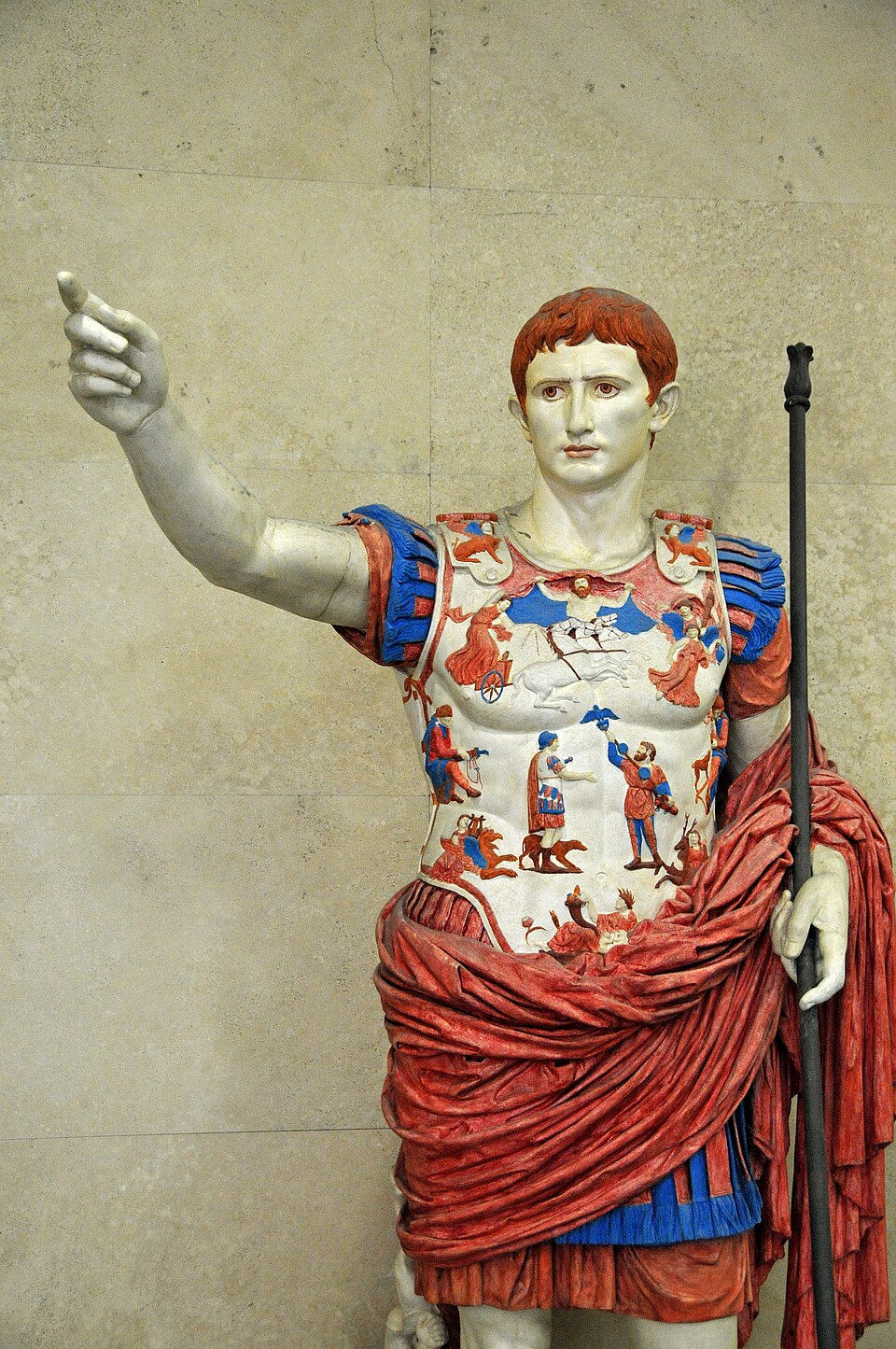
Comments